
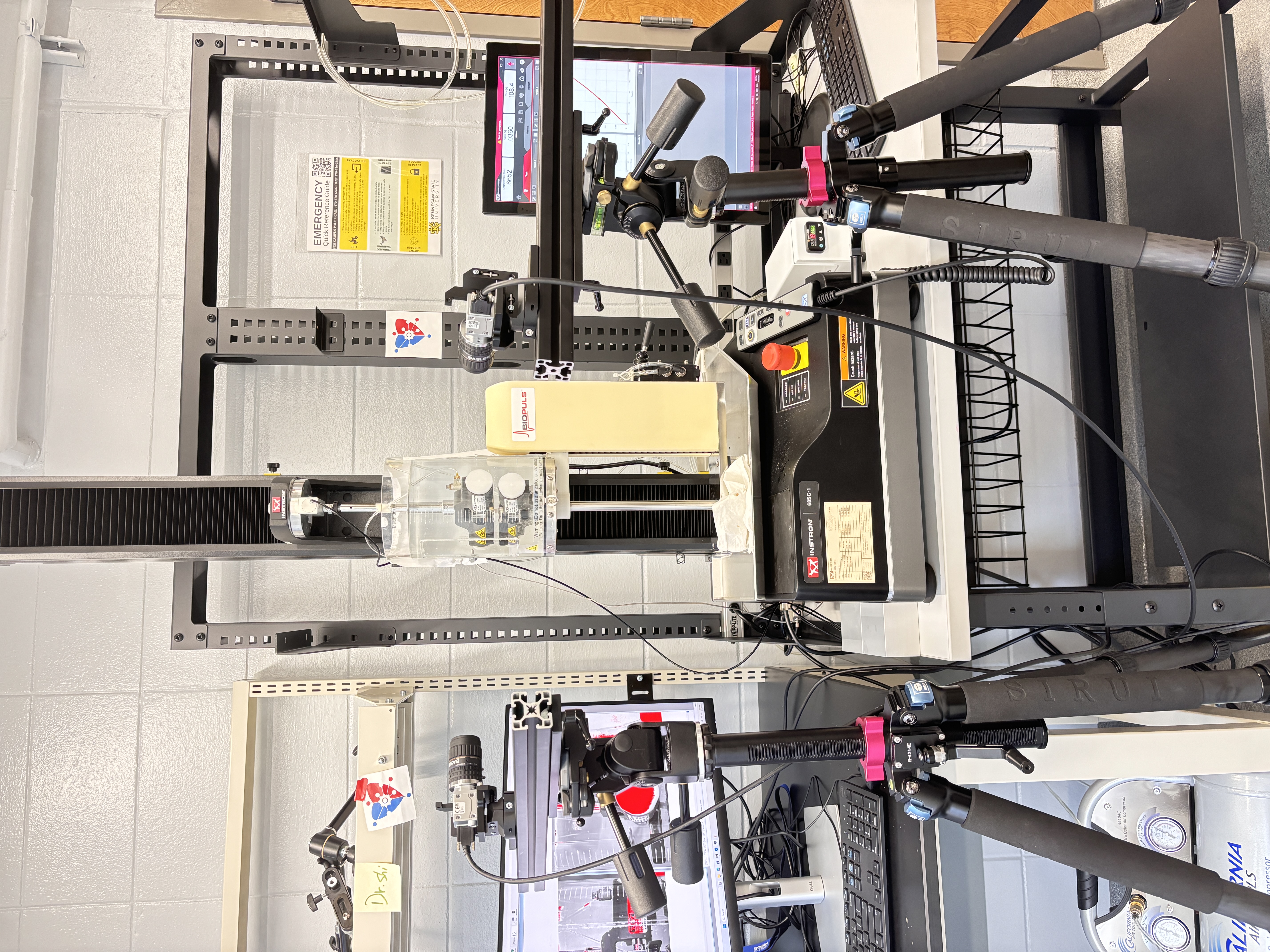
Universal Testing Machine & BioPuls Biobath
| Manufacturer | Instron |
|---|---|
| Model | 68SC-1 |
Our research is supported by competitive federal grants and strong cross-institutional collaborations.




 Research Lead Sanjian Zhang
AI-driven simulation accelerators and predictive models that replace expensive finite element solvers with learned surrogate representations.
We design data pipelines and machine learning models to process experimental and clinical data, classify motility patterns, and accelerate prediction and decision support.
Our machine learning research also explores spatiotemporal modeling of cardiac dynamics. Sanjian Zhang studies how to integrate cardiac structures reconstructed from CT/MRI with physiological signals, such as blood pressure, and clinical variables to model and predict cardiac motion throughout the cardiac cycle.
Our flagship ML framework converts cardiac finite element meshes into graph structures, learning the relationship between geometry, material properties, loading conditions, and tissue deformation, at 13,000× GPU acceleration and 190× CPU acceleration compared to traditional FEA, with median error under 0.13%.

Flexible node connectivity on unstructured cardiac meshes.
Mesh-aware spatial embedding via Laplace equation solutions.
Adaptive message passing with dynamic neighbor weighting.
Efficient subgraph sampling to reduce memory footprint.
Tell us your major, year, and what caught your eye. We'll reply within a week.
 Research Lead Nanlong Sun
Cross-scale computational modeling and coupled multiphysics simulations, from molecular ion channels to whole-organ electromechanics.
We integrate CT scans, endoscopy images, and manometry data from clinical collaborators to build accurate 3D models of the stomach, esophagus, and heart. These models are the geometric foundation for every digital twin we construct.
On top of that geometry, we develop patient-specific digital twins that couple tissue mechanics with electrical activity to simulate how each organ contracts, moves, and responds to disease or surgical intervention.
Implicit coupling framework that integrates 0D ion-based electrophysiology models with 3D finite-element solid mechanics, enabling patient-specific simulation of cardiac and gastric motility.

Figure 1: Multiscale modeling of a patient-specific cardiac digital twin.
Nonlinear finite-element mechanics with large deformation kinematics.
Ion-channel models of electrical activity (e.g., Hodgkin-Huxley type).
Bidirectional coupling between tissue deformation and electrical activity.
0D and 3D models solved together within one implicit coupling framework.
Integration of time-phase CT and MRI imaging to construct personalized 3D organ geometries that evolve physiologically throughout the cardiac or respiratory cycle.
Patient-specific mechanical predictions for improved clinical accuracy.
Pre-operative biomechanical simulation of bariatric and GI procedures.
Optimizing electrode placement for electrical stimulation devices.
Efficient computation enabling large-cohort biomechanical research.
Tell us your major, year, and what caught your eye. We'll reply within a week.
 Research Lead Yue Li
Physics-based material models that capture the complex, nonlinear behavior of biological soft tissues under large deformation.
Every simulation we run depends on how accurately it describes the tissue itself. Stomach, cardiac, and other soft tissues show both elastic recoil and time-dependent relaxation, so our models are calibrated against the mechanical tests performed in our lab.
We develop microstructure-informed material models that combine hyperelastic equilibrium response with viscoelastic rate-dependent behavior, which is essential for accurate simulation of soft tissues that exhibit both elastic recoil and time-dependent relaxation.

Figure 1: Computational biomechanics modeling of soft tissue.
Material parameters tied to collagen fiber architecture and ground substance properties.
Validated across physiological strain ranges (up to 40–60%) with anisotropic fiber reinforcement.
Prony-series based time-dependent response with separable hyperelastic equilibrium.
Identified via inverse calibration against biaxial, uniaxial, and shear experimental data.
Tell us your major, year, and what caught your eye. We'll reply within a week.
Explore our laboratory equipment and contact us to discuss experimental testing and research collaborations.
| Manufacturer | Instron |
|---|---|
| Model | 68SC-1 |
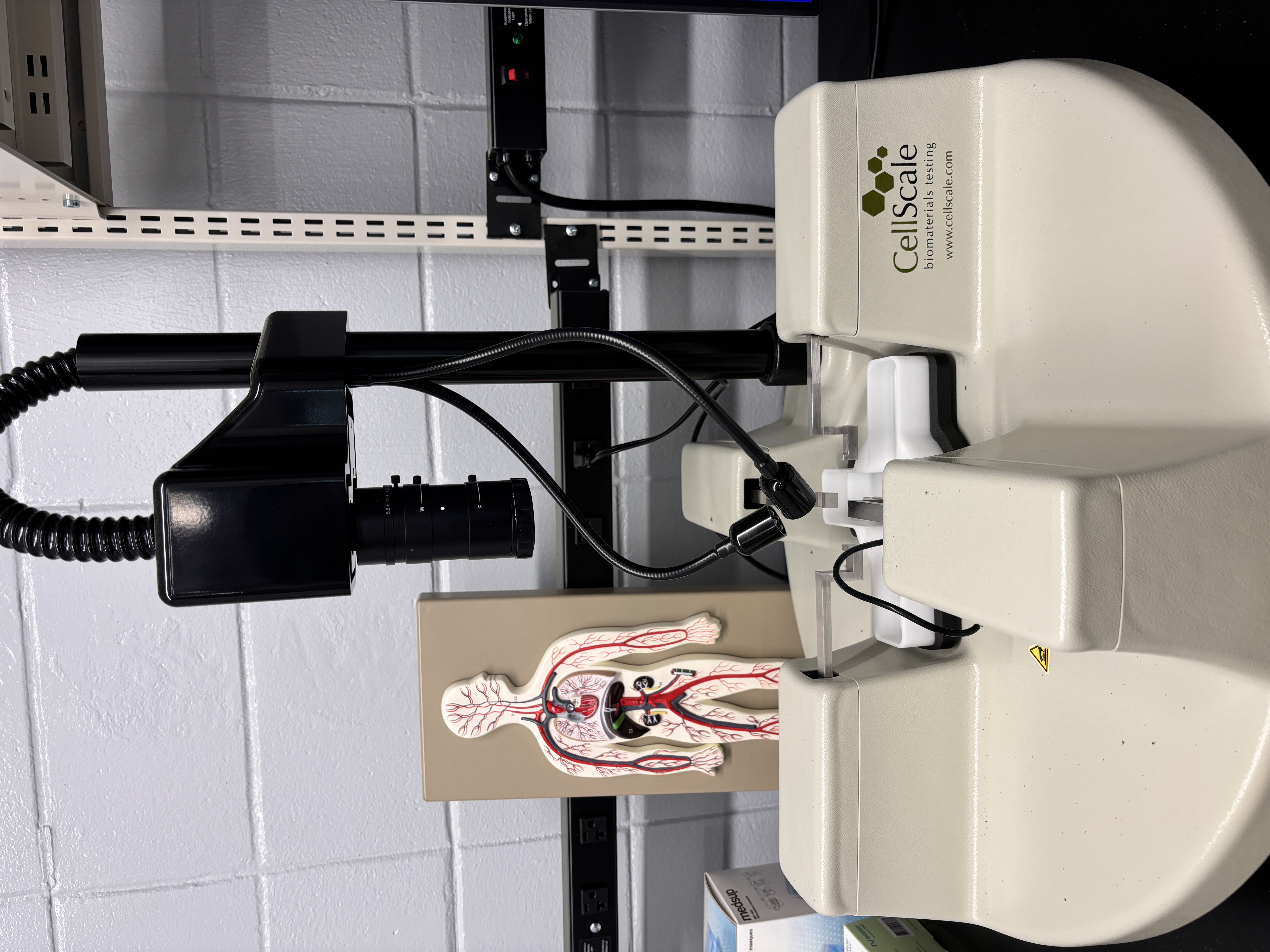
| Manufacturer | CellScale |
|---|---|
| Model | Contact us for model details |
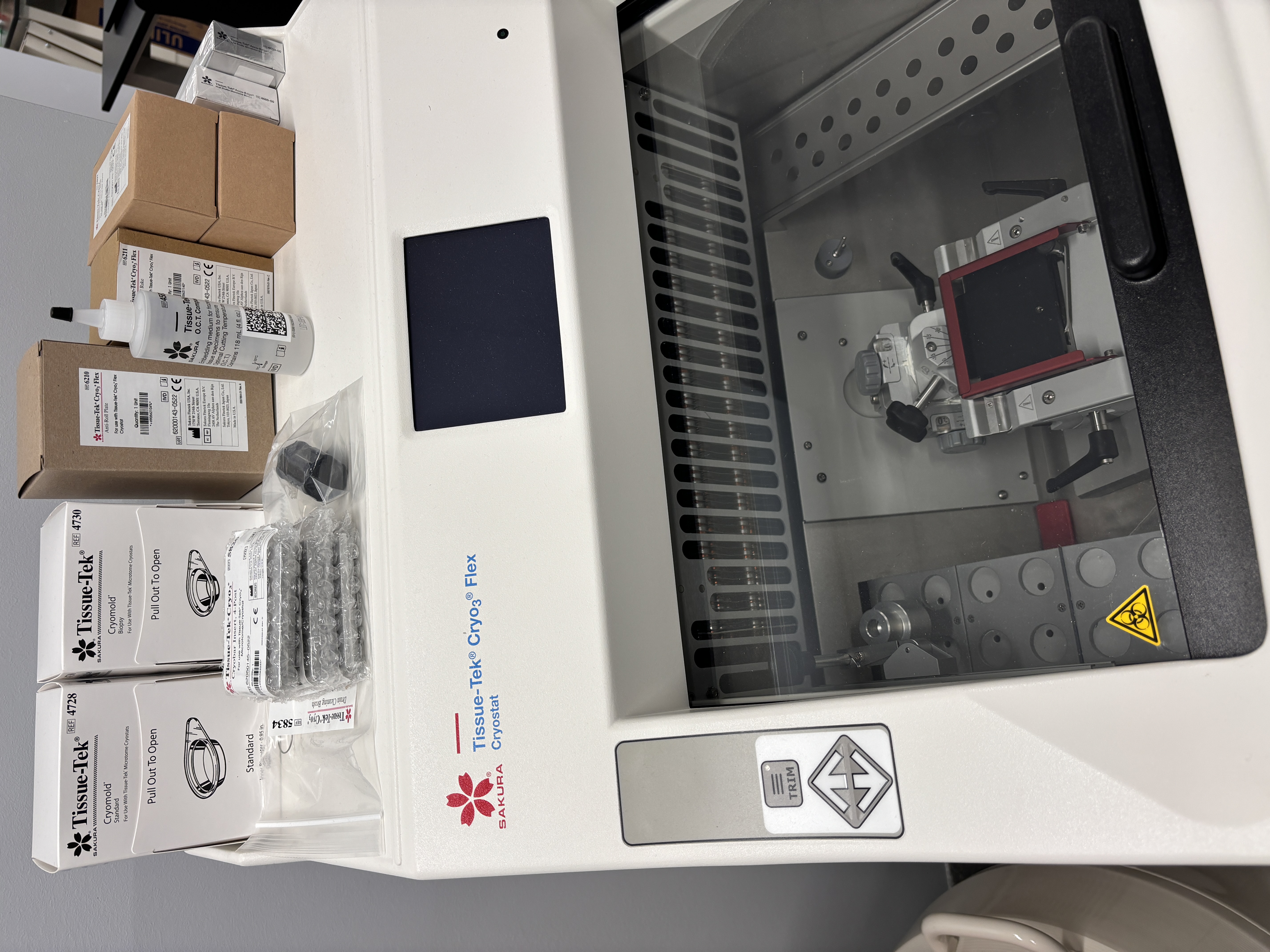
| Manufacturer | Sakura |
|---|---|
| Model | Tissue-Tek Cryo3 Flex |
Share your research goals, sample type, testing needs, and expected timeline with our team.